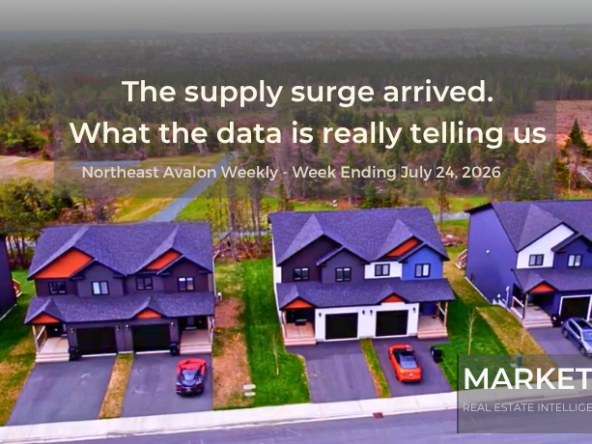
I watched a listing sit for two weeks. A 4,400 square foot home in an established neighborhood, priced at $850,000. Only 8 years old. Modern finishes, fully ducted heat pump and large, detached garage. Mature lot.
Then in a single day, three showings were scheduled. Two offers came in by the end of the week.
Nothing about the house changed. What changed was the buyer pool. Two of those three buyers had spent months trying to rationalize the cost of building new. They stopped trying.
When the New Construction Math Breaks Down
This is happening in a specific segment of the St. John’s market right now. Homes in the 3,000 to 4,000 square foot range, priced between $650,000 and $850,000.
Buyers in this range have been running the numbers on new construction for months. Land prices jumped significantly over the past 8 to 12 months. Construction costs followed. The gap between what they want to build and what they’re willing to spend keeps widening.
At some point, the math stops working. A $50+ per square foot variance between new construction and resale becomes impossible to ignore.
When you add finished basements, upgraded kitchens, fenced yards, detached sheds, and mature landscaping, resale properties in this price range are offering measurably more value.
The economics shifted. The buyer psychology followed.
The Psychological Pivot
What’s interesting is watching buyers make this shift in real time.
They’ve been emotionally committed to building new. They’ve looked at floor plans. They’ve talked to builders. They’ve walked lots in new developments.
But the numbers keep coming back wrong.
So they open their search to resale. Not enthusiastically at first. More like a fallback option. A compromise.
Then something shifts. The house that felt like settling starts looking like smart money. The “dated” finishes become $50/sqft savings they control. The finished basement they were planning to build is already done. The fence, the shed, the mature trees, the walkable location all start adding up differently.
What Buyers Are Rationalizing Now
I’m hearing the same reframes from buyers in this segment:
“We were going to spend $200,000 finishing the basement anyway.” When they find a resale property with a finished basement, that cost disappears from their mental ledger.
“The fence, shed, and landscaping would have cost us $30,000+.” Extras that come with resale suddenly have tangible dollar value they were already planning to spend.
“We’re paying for location, not just square footage.” Established neighborhoods with mature trees, walkable schools, and existing infrastructure start outweighing the appeal of brand new subdivisions.
“We move in next month, not 18 months from now.” In a market where new builds face delays and supply chain issues, immediate occupancy becomes a real advantage.
This is rational calculation changing emotional priority. Research confirms that up to 90% of our decisions are influenced by emotions. When the financial math shifts this dramatically, buyers find new ways to emotionally justify what now makes sense on paper.
What’s Happening in St. John’s
While much of Canada experienced cooling markets in 2025, St. John’s prices climbed nearly 10% year over year in December 2025. We’re operating in our own market reality.
Months of inventory dropped to 5.4 at the end of April 2026, down from 6.9 the year before, and well below the long-run average of 11.6 months. The number of houses available for sale has dropped to historic lows in the St. John’s region.
We don’t have a demand problem. We have a supply problem.
But in the $650,000 to $850,000 range, something specific is happening. Buyers who were exclusively focused on new construction are scheduling showings for resale properties. They’re tired of trying to make the new construction math work.
Why New Construction Still Sells
Here’s what people get wrong: they assume if resale is attracting new construction buyers, new builds must be struggling.
That’s not what I’m seeing. Both are moving. But they’re serving different buyer priorities.
New construction buyers want customization, warranties, modern systems, and the emotional appeal of “new.” They’re willing to pay the premium and wait for what they want built to spec. For them, the math still works.
Resale buyers are doing value arbitrage. They see the $50/sqft difference, the finished basement, the shed, the fence, the mature yard, and they’re making a financial decision that feels emotionally smart. For them, the premium stopped making sense.
Different buyers. Different breaking points. Different decisions.
The Inventory Reality
In most markets, when prices rise this fast, inventory floods in to meet demand. Sellers list. Supply increases. Prices stabilize.
That’s not happening here.
Total listings decreased 2.4% from 2024 to 2025, even as sales increased 4.4%. We’re selling more homes while fewer come to market.
Why? Because replacement cost is the highest we’ve ever seen. Homeowners who would normally sell and buy something bigger are looking at new construction prices and staying put. They’ll renovate instead.
This creates a compounding effect. Limited inventory drives competition. Competition drives prices. Higher prices make replacement more expensive. More expensive replacement keeps potential sellers from listing.
The cycle reinforces itself.
What This Means If You’re Selling
If you’re thinking about listing a resale property in the 3,000 to 4,000 square foot range, priced between $650,000 and $850,000, understand the advantage you have right now.
You’re competing against new construction costs that are making buyers rethink their plans. They’re doing the math on finishing basements, building fences, installing sheds, waiting 18 months for occupancy. Your property already has those boxes checked.
Position accordingly:
• Highlight finished spaces with context: “Finishing a basement this size costs $180,000+ today”
• Emphasize immediate occupancy: “Move in next month, not next year”
• Showcase completed upgrades: fence, shed, landscaping, hardscaping with approximate replacement costs
• Price competitively knowing your real competition is new construction, not just other resale listings
If you’re buying in this range, recognize the shift happening. Homes that would have sat for weeks two years ago are now getting multiple showings once buyers exhaust their new construction options. When something checks your boxes, move fast.
What I’m Watching Now
The buyers I’m working with in this price range are asking different questions than they were six months ago.
Less: “Do we get to pick all the finishes?”
More: “What would finishing the basement ourselves cost today?”
Less: “When will our new build be ready?”
More: “How fast is the seller willing to close?”
Less: “What’s included in the builder’s base package?”
More: “What’s already included with this house?”
Less: “Is the new development near good schools?”
More: “Can we walk to the school from here?”
These aren’t random shifts. These are buyers getting tired of trying to rationalize new construction costs that keep climbing.
When land prices jump and construction costs follow, there’s a breaking point. The emotional commitment to “new” runs into financial reality. At some point, buyers stop trying to make the math work and start looking at what already exists.
The Bigger Pattern
St. John’s is operating in its own market reality right now. While much of Canada cooled in 2025, we kept climbing. We’re not following national trends.
But the psychological shift happening here in the $650,000 to $850,000 range is worth paying attention to, because the economics are universal.
When replacement costs rise faster than resale prices, the value equation flips. When new construction carries a $50/sqft premium, buyers reach a breaking point. When finished basements, fences, and sheds cost $200,000+ to add, buyers start valuing properties that already have them.
The house doesn’t care what the market thinks.
But buyers care deeply about value. And right now, in this specific segment of our market, resale is offering something new construction struggles to match: more house for your money, available now, in established locations.
That’s not a temporary sentiment shift. That’s buyers responding rationally to economic reality they’re tired of trying to rationalize away.