

Are you waiting for the perfect moment to right-size your home?
Most people are.
And that’s exactly why they end up making the decision under pressure instead of on their terms.
If you’ve lived in your home for 20, 30, or even 40 years, this doesn’t feel urgent.
You manage the house. You’re comfortable. You believe you have time.
But the reality is:
The best time to right-size isn’t when you have to.
It’s when you still have control.
What Is Right-Sizing?
Right-sizing means adjusting your living situation to better fit your current and future needs – whether that means moving to a smaller, more manageable home, a more accessible space, or simply a place that aligns better with your lifestyle.
Unlike “downsizing,” which can feel like a loss, right-sizing is about gaining freedom, flexibility, and control.
Why Most People Right Size Too Late
Often, right-sizing happens reactively:
- A health crisis forces the decision.
- A fall makes stairs impossible.
- Family members step in and start making calls.
This reactive pattern leads to:
- Lower sale prices
- Rushed decisions
- Loss of control
- Emotional trauma
- Financial inefficiency
The data shows worse outcomes across every variable when rightsizing is delayed.
The St. John’s Right-Sizing Wave
This isn’t theoretical. It’s a demographic wave already underway.
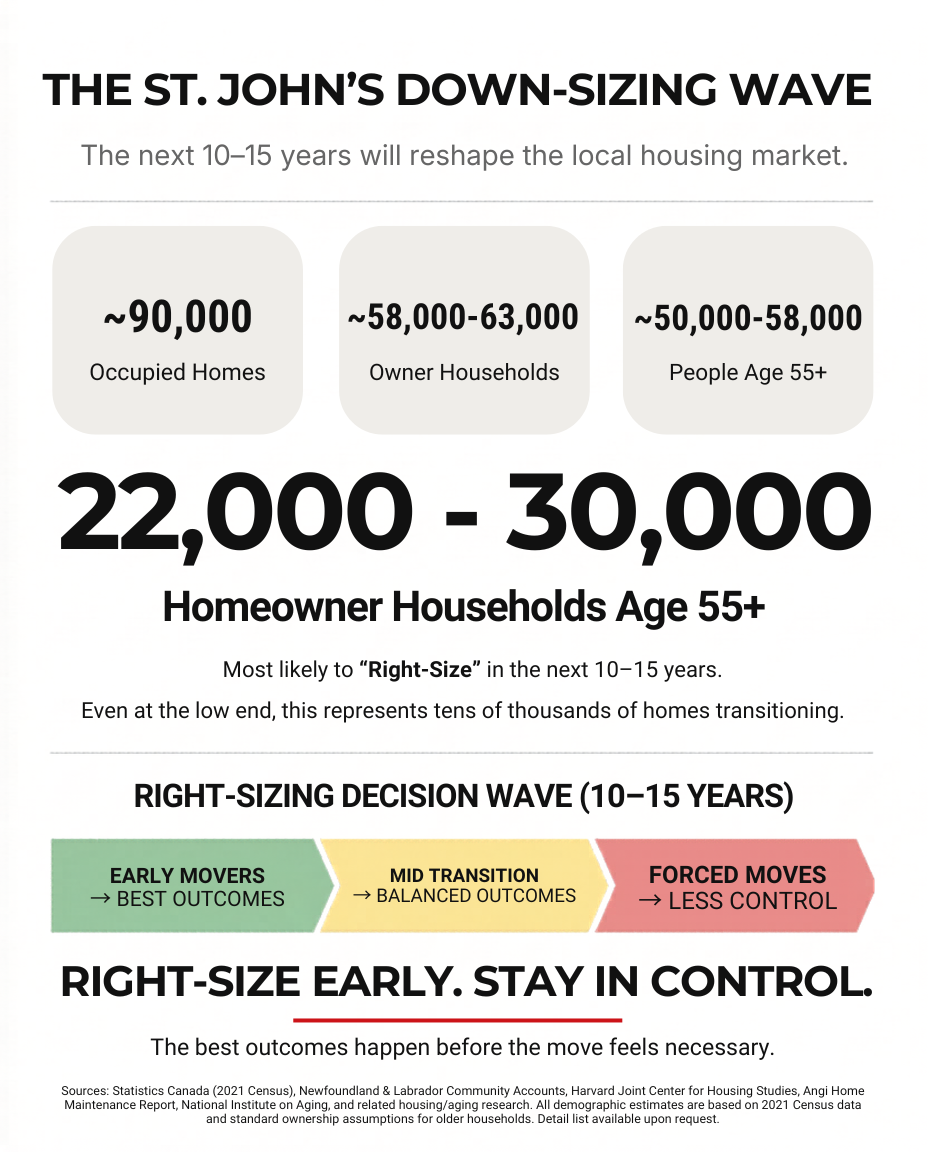
- ~90,000 occupied dwellings in the St. John’s CMA
- ~58,000–63,000 are owner-occupied
- ~70,000–80,000 people are age 55+
Based on typical ownership patterns:
Estimated homeowner households age 55+:
~22,000 to 30,000 households
Why This Matters
This is not a niche.
Over the next 10–15 years, tens of thousands of homeowners will face a right-sizing decision.
Most are living in homes that no longer match their future needs:
- Larger than necessary
- Increasingly maintenance-heavy
- Often multi-level
- Emotionally anchored to the past
The Optimal Rightsizing Window
The best time to right size is 5-10 years before most people feel they have to. This feels counterintuitive because:
- You’re healthy.
- You manage your home.
- You believe you have time.
But this is exactly when you should make the move.
The Three-Dimensional Erosion of Waiting
Every month you delay costs you roughly 0.5-1% in negotiating power. This erosion happens across three dimensions:
1. Declining Capacity
- At 65, you might still manage attic access and decluttering.
- At 72, you might need some help.
- At 78, you likely depend on others.
Declining capacity means you may have to hire help, adding costs and reducing control.
2. Market Perception
- Homes sitting on the market too long signal problems.
- After 90 days, buyers become skeptical, assuming pricing issues.
3. Physical Decay
- Gutters clog.
- Paint fades.
- Gardens overgrow.
Small maintenance issues compound, signaling neglect and weakening your position.
The Deferred Maintenance Multiplier
Consider a roof replacement costing $10,000 – $12,000. Buyers don’t just subtract this cost; they factor in:
- Risk and hassle
- Uncertainty about other hidden problems
- Insurance concerns
- Immediate repair coordination
This leads to offers $20,000-$25,000 less than asking price — double the actual repair cost.
How to Avoid This
- Get a pre-listing inspection (~$750) before buyers walk through.
- Fix high-visibility repairs.
- Price the rest intentionally.
This approach removes buyer uncertainty, tightens negotiations, and protects your equity.
Example: Repair Costs vs Buyer Perception
| Issue | Actual Repair Cost | Buyer’s Perceived Cost |
| Roof Replacement | $12,000 | $20,000 |
| Furnace Repair | $4,000 | $8,000 |
| Foundation Sealing | $3,000 | $10,000 |
| Total | $19,000 | $38,000 |
If you fix repairs before listing, you spend $19,000 but avoid losing $19,000+ in buyer discounts.
Timing Is Everything
- If you have 12 months or more before moving, get multiple quotes and schedule repairs strategically.
- If you’re under time pressure, don’t fix repairs. Price aggressively and move fast.
- The worst scenario is trying to fix repairs while rushed – paying premium rates and still losing value.
The Timing Paradox
The best time to right size is before you feel you have to.
Once you feel forced, you’ve already waited too long.
Think about people you know who moved in their late 70s or 80s because they had to. Their experiences are often:
- Chaotic
- Expensive
- Stressful
- Out of their control
The Capital Reallocation Framework
Right-sizing isn’t about loss – it’s about capital reallocation and optimizing constraints.
Many focus on what they’re losing instead of what they’re gaining:
- Freedom from maintenance burdens
- Financial flexibility
- Reduced stress
Large homes often become negative cash flow assets in retirement. Consider:
- Rising cost-burden rates for older homeowners (24% in 2019 to nearly 28% in 2023)
- Average annual home maintenance costs of $6,413
- Most older adults rely primarily on Social Security income
Waiting five extra years to right size means missing out on investment growth — potentially $50,000+ at a conservative 5% return on $200,000 equity.
Start Your Rightsizing Journey Today
You don’t need to decide immediately, but you should start planning.
Here’s how:
- Walk your home like a buyer. Note repairs over $5,000.
- Begin light decluttering with the 15-minute rule: tackle one drawer, closet, or box at a time.
- Explore 2-3 replacement housing options early — no commitments, just information.
- Get a no-pressure valuation and strategy review to know your numbers.
For Adult Children Reading This
The biggest mistake families make is waiting for a crisis.
Start conversations early — not about selling, but about options.
Help your parents maintain control over their decision. Forced moves correlate with:
- Worse health outcomes
- Higher stress
- Lower life satisfaction
Frame discussions around choice, not necessity.
Ready to Plan This the Right Way?
If you’re thinking about rightsizing in the next 12–24 months, the goal isn’t to rush a decision.
It’s to get ahead of it.
I work with clients to build a clear, strategic plan before anything feels urgent:
- Identify issues before buyers do
- Decide what to fix vs. price
- Position the home to protect your equity
- Map out timing so you stay in control
No pressure. No obligation.
Just a clear understanding of your options—while you still have them.
Remember: The difference between a good move and a forced one is timing.
Start early. Stay in control. Move on your terms.
If you want help or have questions about rightsizing in the St. John’s market, feel free to reach out. Your future self will thank you.